





A. Activity details
Students will design and implement the mechanism based on which a tank is filled with liquid every time its level falls below a set limit.
Purpose
Enhancing Students’ understanding of the basic principles of automation and robotics,
encouraging creativity, programming, and collaborative work, are
the teaching objectives of this activity. Familiarity with the use of
LEGO building blocks to create the mechanism and learning the basic structures
and commands of the micro:bit programming platform to control the construction.
The design of the automation based on specific criteria, such as height, length, balance
and number of moving parts and programming the micro:bit to control the automation.
The operation of the liquid level sensor.
Troubleshooting during the creation, programming and operation of automation
through smooth collaboration and communication with other students to achieve common goals.
Finally, the joint evaluation that will lead to the selection of the best solutions for the subject.
Objectives
- I define (Knowledge): the basic function of the liquid level sensor. The concept of the diagram and the recording of values on the two axes x and y.
- I define (Knowledge): Calculation formulas if height x,
volume (V = x * S),
mass (m = ρ * x * S)
weight (Β = γ * x * S) - I choose (Knowledge): The appropriate passive and active elements that I will need for my construction.
- I recognize (Knowledge): The use of automation in industry and in our daily lives.
- I describe reasons for (Understanding): why the use of automation is important in industry and our daily lives.
- I assemble (Implementation): The passive and active elements required for the balance and stability of my construction.
- I list the components (Analysis): of the automation under construction.
- I prepare (Synthesis): A plan for the utilization of the elements of the liquid level recognition automation.
- I predict (Analysis): The size of the elements of the construction, always according to the original plan.
- I reflect (Evaluation): On the best possible utilization of the options for starting the movements of each element of my construction.
- I modify (Implementation): My construction so that it is as effective as possible, according to the original goal.
- I evaluate (Evaluation): The method of application and the result of the operation of the arm.
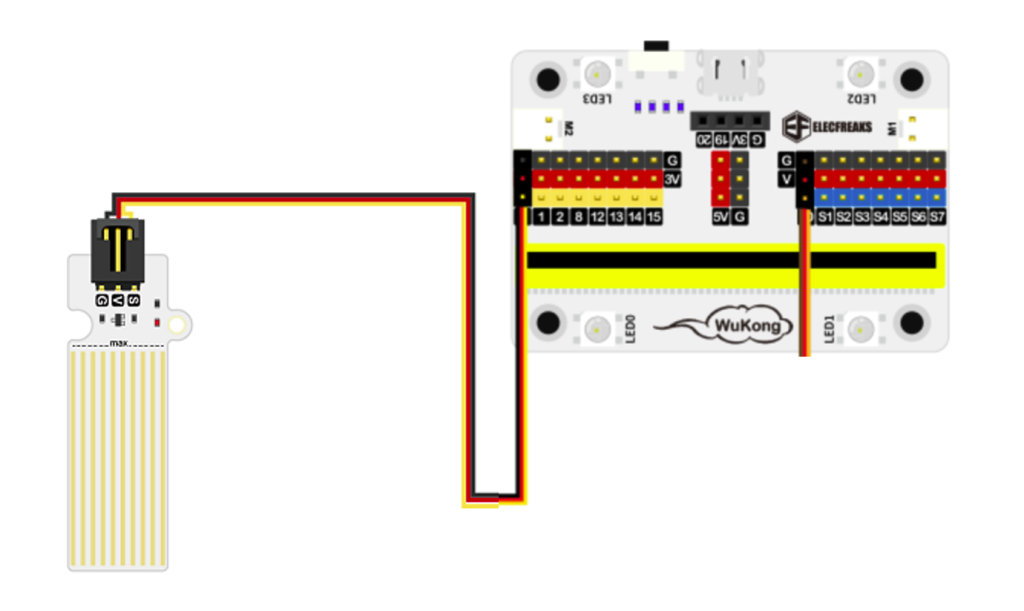
B. Connections
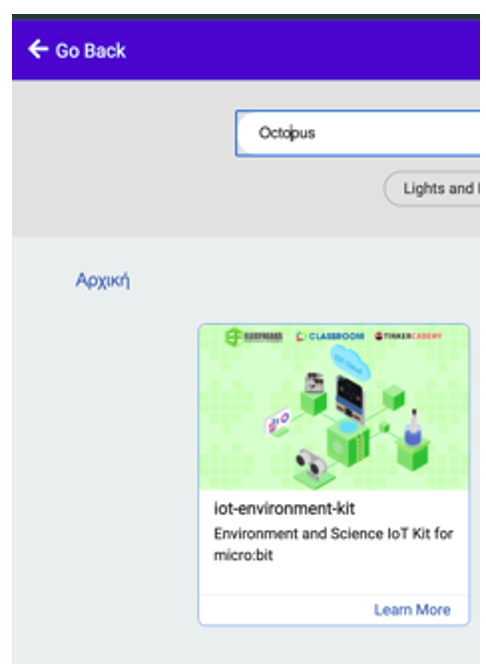
C. Library
D. The program
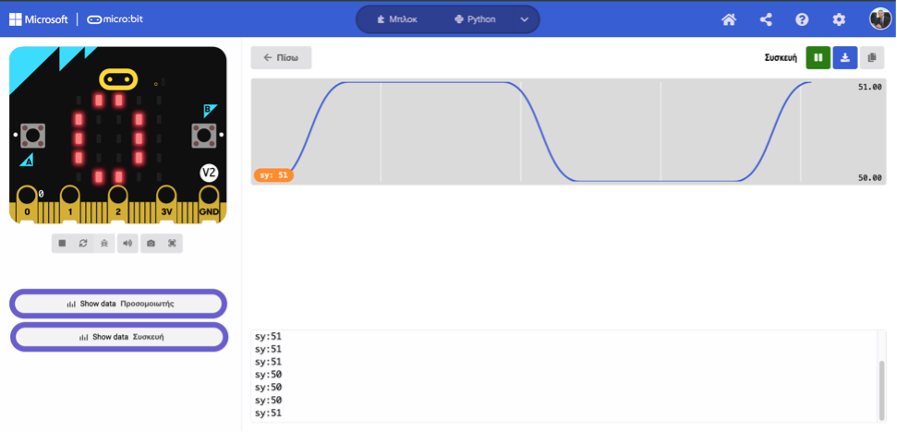
Displays the measurement value on the micro:bit LED panel and assigns the corresponding values to the variable sy which is represented in the diagram of the axes x=sampling time and y=measurement (see next screenshot).
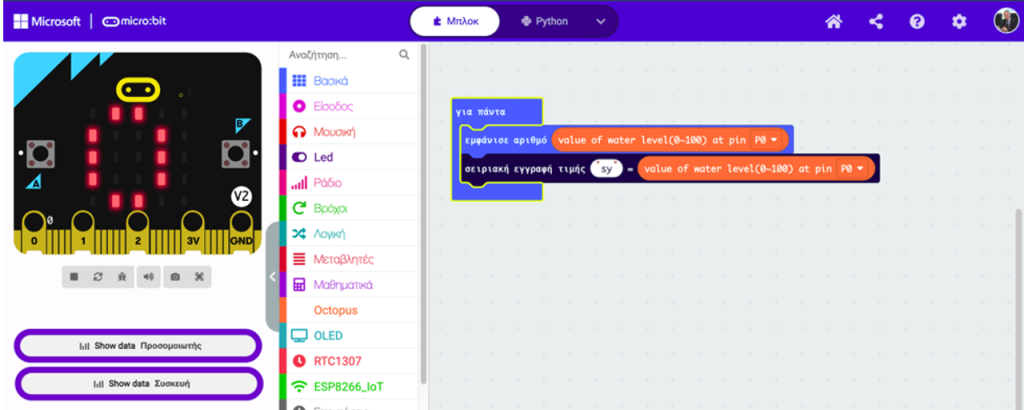
The liquid level measurement is plotted on a graph where the x-axis shows the samplings and the y-axis shows the measurements. The collected data can be exported to a .CSV file and read by any .EXCEL like program.